
For as long as people have loved and lost, we’ve searched for ways to say goodbye. Every culture, from ancient tribes to modern cities, has developed its own way of honouring those who’ve passed. Some built tombs that touched the sky; others gathered under trees to share stories. Over time, these rituals changed with the world around us.
Today, cremation has become one of the most common ways families choose to say farewell. It’s simple, dignified, and deeply personal. But this wasn’t always the case. The story of cremation stretches back thousands of years, shaped by faith, culture, and the way people understand life and death.
Where It All Began
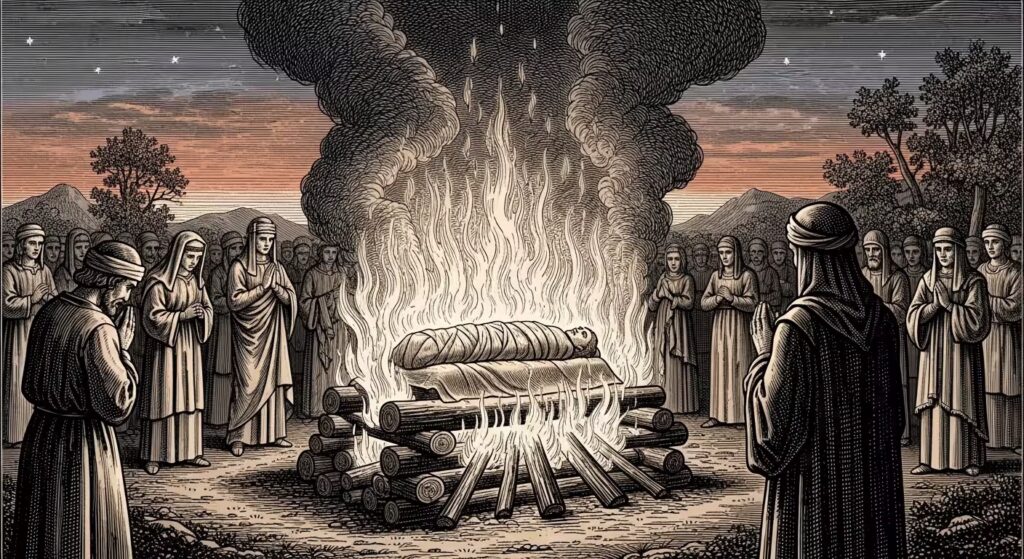
Cremation is one of humanity’s oldest practices. Archaeologists have found evidence of it as far back as 20,000 years ago, in the remains of Mungo Lady in Australia. Even then, people saw fire as something sacred — not just a source of warmth, but a symbol of transformation and release.
In ancient Greece and Rome, cremation became a sign of honour and respect. Warriors and leaders were often cremated so their spirits could rise with the smoke, freed from the body that once carried them. In Homer’s Iliad, Achilles cremated his fallen friend Patroclus, believing it would help his soul reach the next world.
In India, cremation has long been tied to faith. For Hindus, it represents the body’s return to the elements — fire, air, water, and earth — and the soul’s journey toward rebirth. Buddhism, too, embraced cremation as a reminder of impermanence: that everything changes, and that peace lies in letting go.
But in much of Europe, the rise of Christianity brought a different belief. The body was seen as sacred, destined for resurrection. Cremation faded from practice, replaced almost entirely by burial. For centuries, the idea of cremation all but disappeared in the Western world.

The Return of Cremation
It wasn’t until the 1800s that cremation began to re-emerge. Cities were growing rapidly, and overcrowded cemeteries became a serious problem. Graveyards overflowed; sanitation was poor; disease spread easily. Reformers and scientists began to question whether burial was still practical — or even safe.
In 1873, an Italian professor named Ludovico Brunetti introduced a new invention: a modern cremation chamber. It used heat, rather than open flame, to carefully return a body to ash. The first modern crematorium opened soon after in Milan, and others followed across Europe.
In Britain, the idea caught on among doctors and social reformers who saw cremation as cleaner and more dignified. Despite strong resistance from churches, the first crematorium opened in Woking in 1885. Slowly, the practice began to take hold.
For many, cremation came to symbolise progress — a reflection of a world moving toward science, reason, and hygiene. What began as a necessity became an act of choice.
A Changing World, A Changing View
The 20th century brought an enormous shift in how people approached death. As societies became more urban and less religious, old taboos started to fade. Families began looking for simpler, more personal ways to remember their loved ones.
In 1963, the Catholic Church officially lifted its ban on cremation. That moment changed everything. Suddenly, millions of people who had never considered it before began to see cremation as a meaningful alternative to burial.
At the same time, cremation technology improved dramatically. The process became faster, safer, and more environmentally responsible. People no longer saw it as something cold or clinical, but as an option that offered more choice and more flexibility.
By the end of the century, cremation had moved from the margins to the mainstream. It reflected a new way of thinking — one that valued personal meaning over tradition alone.
Cremation in South Africa
In South Africa, the change came gradually. For many decades, burial was simply how things were done. It was familiar, tied to culture, faith, and family history. But as cities like Cape Town grew, cemeteries filled up and space became limited.
Cremation offered a practical and respectful solution. Over time, it also became an emotional one. Families saw how it could be both simple and significant — a farewell that honoured the person’s life without the same formalities or costs of a burial.
Today, cremations are a natural part of life in South Africa. At Bayview Funeral Home, we often meet families who appreciate that cremation gives them more choice. Some hold a traditional service at our chapel; others prefer a small private gathering by the sea. Many choose to scatter ashes somewhere meaningful — a mountain path, a garden, or the ocean waves.
Each choice tells its own story. And that, perhaps, is what has made cremation so meaningful in modern times. It allows families to celebrate a life in a way that feels true to them.
Modern Influences: Technology and the Environment
Modern cremation has changed not only through culture but also through technology. Today’s crematoriums are designed to be environmentally responsible, using advanced filtration systems and efficient energy use to minimise emissions.
There’s also growing interest in eco-friendly alternatives, such as aquamation (sometimes called water cremation), which uses water and heat instead of fire to achieve the same result. Though still new, it represents how far society has come in seeking gentler, more sustainable options.
Technology has also transformed how we remember. Many families now livestream cremation services for relatives who can’t attend in person, or create online memorials where friends can share memories and photos. These small changes make cremation more personal and connected than ever before.
From Ritual to Reflection
Cremation’s growing popularity isn’t just about cost or convenience. It also reflects how people now think about life, death, and memory.
In the past, funerals often followed a strict formula. They were solemn, formal, and led entirely by tradition. Today, people are creating farewells that are deeply personal. Some want quiet reflection; others prefer a celebration of life. Cremation supports this freedom. It gives families the space to grieve and remember in their own way.
Without the boundaries of a gravesite, families can scatter ashes somewhere meaningful, hold memorials later, or even create keepsakes that hold a small portion of ashes as a lasting reminder.
This shift from ritual to reflection shows how our culture has evolved. We’re no longer just following old customs — we’re finding comfort in what feels right for us.
Why Cremation Keeps Growing
Across the world, cremation has become the most common way to say goodbye. In places like Japan and the United Kingdom, it accounts for more than 70% of funerals. South Africa is following the same path, especially in cities like Cape Town, where space and cost are constant concerns.
But beyond the practical side, there are emotional reasons too:
- Simplicity. Cremation allows families to keep things peaceful and uncomplicated.
- Affordability. It often costs less than burial, removing financial stress during an already difficult time.
- Flexibility. Families can plan a service whenever they’re ready, without the rush that comes with traditional burial.
- Personalisation. There are countless ways to honour a loved one — from scattering ashes at sea to planting a tree in their memory.
- Environmental care. Many see cremation as a way to reduce land use and environmental impact.
Together, these reasons have made cremation a truly modern choice — one that fits the pace, values, and diversity of our world today.
Cremation as a Modern Act of Care
When people talk about cremation, they often think of it as a process. But at its heart, it’s an act of compassion. It’s a way to honour a life, to give the body back to nature, and to carry the memory forward in a way that feels peaceful.
At Bayview Funeral Home, we see every cremation as a moment of care. Our role is to guide families gently through each step — not just the paperwork or logistics, but the emotion behind it. Whether someone wants a quiet service or a simple scattering, the focus is always on dignity, understanding, and respect.
Cremation reminds us that love doesn’t end when a life does. It continues in the stories, the memories, and the moments we hold on to.
Conclusion
From ancient fires to modern chapels, cremation has always symbolised change — the passing from one form to another. What began as a sacred ritual has become a modern way of finding peace.
It speaks to who we are today: people who value meaning over ritual, love over formality, and choice over tradition.
As we look to the future, cremation continues to evolve — blending respect for the past with the compassion and understanding that define the present.
For families looking for caring, professional support with cremations in Cape Town, Bayview Funeral Home is here to help you create a farewell that feels true to your loved one’s life and spirit.